

I analyzed 7,600 Substack posts to map small newsletter engagement trends
A typical post from a newsletter with under 1,000 subscribers gets five likes and no comments. But there still are ways to grow.

Disclosure: This study grew out of an incidental finding from an article I ran last week. I used Claude Code to write the Python scripts and collect posts through Substack’s undocumented API, with the goal of validating the common-sense observation that most small newsletters struggle to be noticed. DM me if you want the methodology, the data, or the code.
If you run a small newsletter, you know the feeling. You spend a week on a post, hit publish, and then a few likes trickle in over the next day. Maybe one comment, if you’re lucky. You start to wonder whether anyone is actually reading on the platform at all. (That was basically my first month here.)
Last week, I noticed that data from my previous study on AI writing trends suggested small newsletters routinely get a lot less engagement than bigger ones. I did some additionl analysis, and confirmed that engagement really is tightly correlated with newsletter size.
If you just started a Substack and feel like it’s an uphill battle, you’re not imagining it. But there are a few strategies that can help, and at the end of this article, I’ll share what’s worked for me.
TLDR: A typical post from a newsletter with under 1,000 subscribers gets about 5 likes, and more often than not, zero comments. Engagement climbs steadily as audiences grow, and the biggest newsletters earn roughly 15 times the likes of the smallest ones. Most “average engagement” figures floating around social media set unrealistic expectations, because they’re inflated by a handful of viral posts. But small newsletters aren’t doomed, and you can build real engagement even without a big list.
Putting new voices in the spotlight
If you’re interested in supporting smaller newsletters yourself, you should be aware of the Stackhunters, a team of writers who curate articles from all over Substack to help readers broaden their horizons and writers get more exposure for original ideas.
The Stackhunters are Chief Absurdist Officer, Jennifer Houle, Kevin Guiney, Dr Sam Illingworth, JHong and Rebecca Watson (ReBe). They’re good folks to follow if you’re new!
Chief Absurdist Officer also runs NOT RISING magazine, which features visually stunning articles covering new voices.
The study design
Using Substack’s undocumented API, I collected 7,631 free, public posts no more than two years old from 485 randomly selected newsletters. (You can learn more about Substack’s API here.)
The API returned a free-subscriber count for each newsletter, which let me sort them into four size bands: under 1k subscribers, 1k to 10k, 10k to 100k, and 100k or more (78, 152, 149, and 106 newsletters respectively). Then I looked at likes, comments, and restacks.
Reporting the median instead of the mean
Engagement on Substack is wildly lopsided; most posts get a modest response and a few go viral. Engagement averages are skewed by these viral hits, overstating how well a normal post can do. This is why I reported the median (e.g., the post sitting in the middle of the pack), which is closer to what a typical writer experiences.
Aggregating per newsletter
I found each newsletter’s median post engagement first and then calculated the median engagement for the newsletters in each band. I did this to prevent the most prolific writers from having a disproportionate impact on results.
Showing the variability
Each band median included a 95% bootstrap confidence interval, which estimates how much results could vary if the newsletters were resampled. A wider interval means greater potential variability and lower confidence.
Engagement climbs steadily with size
Here is the engagement ladder, in median likes per typical post.
Under 1k subscribers, about 5 likes (95% CI 4 to 7)
1k to 10k, about 14 likes (11 to 17.5)
10k to 100k, about 27 likes (18 to 37)
100k or more, about 77 likes (49.5 to 114)
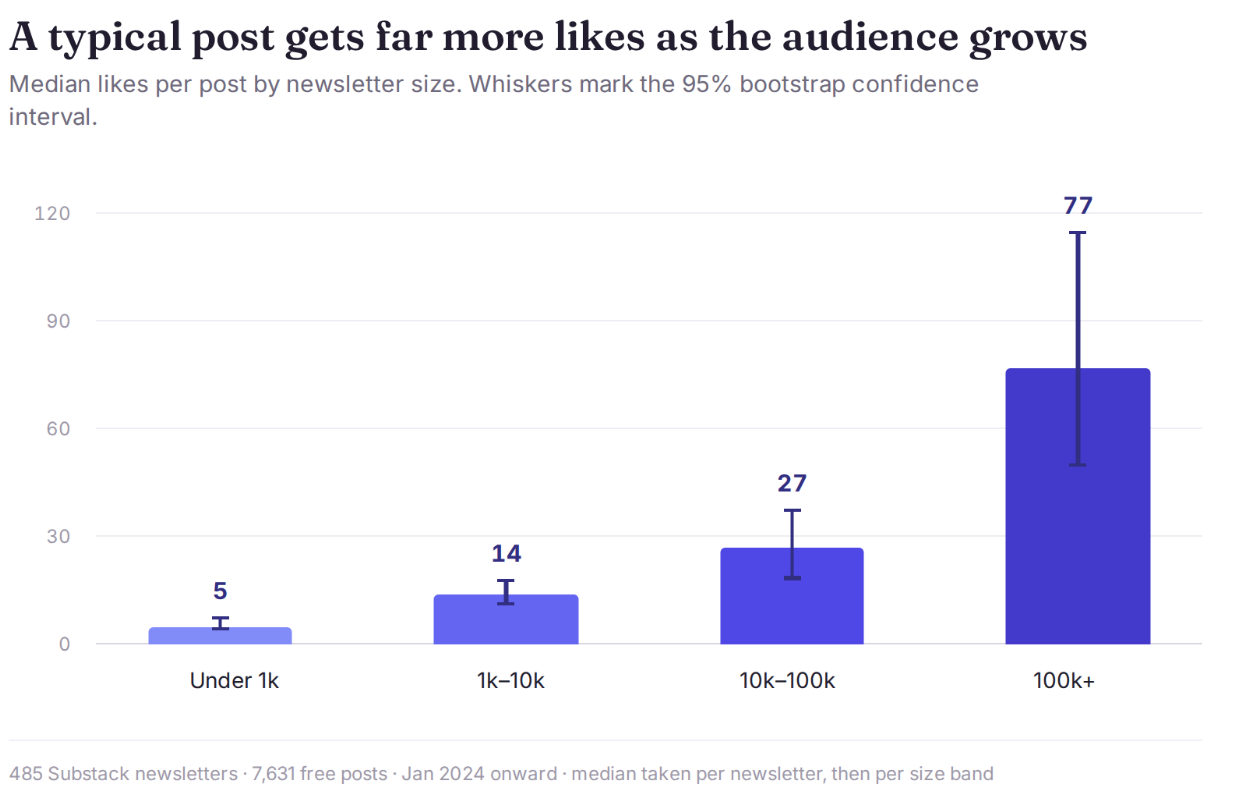
The results are clear and consistent with most writers’ lived experience. Bigger newsletters get a lot more engagement. Also, the confidence intervals for size bands don't overlap, suggesting a significant effect. A post from a 100k+ newsletter pulls about 15 times the likes of a post from a sub-1k newsletter.
Restacks and comments behave the same way, but on a smaller scale. A typical small-newsletter post receives about one restack and usually no comments. A typical post from a 100k+ newsletter gets around four of each.
More than half of small-newsletter posts get zero comments
If you want to encapsulate the “shouting into the ether” feeling into a single statistic, this is it. Among newsletters under 1,000 subscribers, 51% of posts got zero comments and 44% got zero restacks.
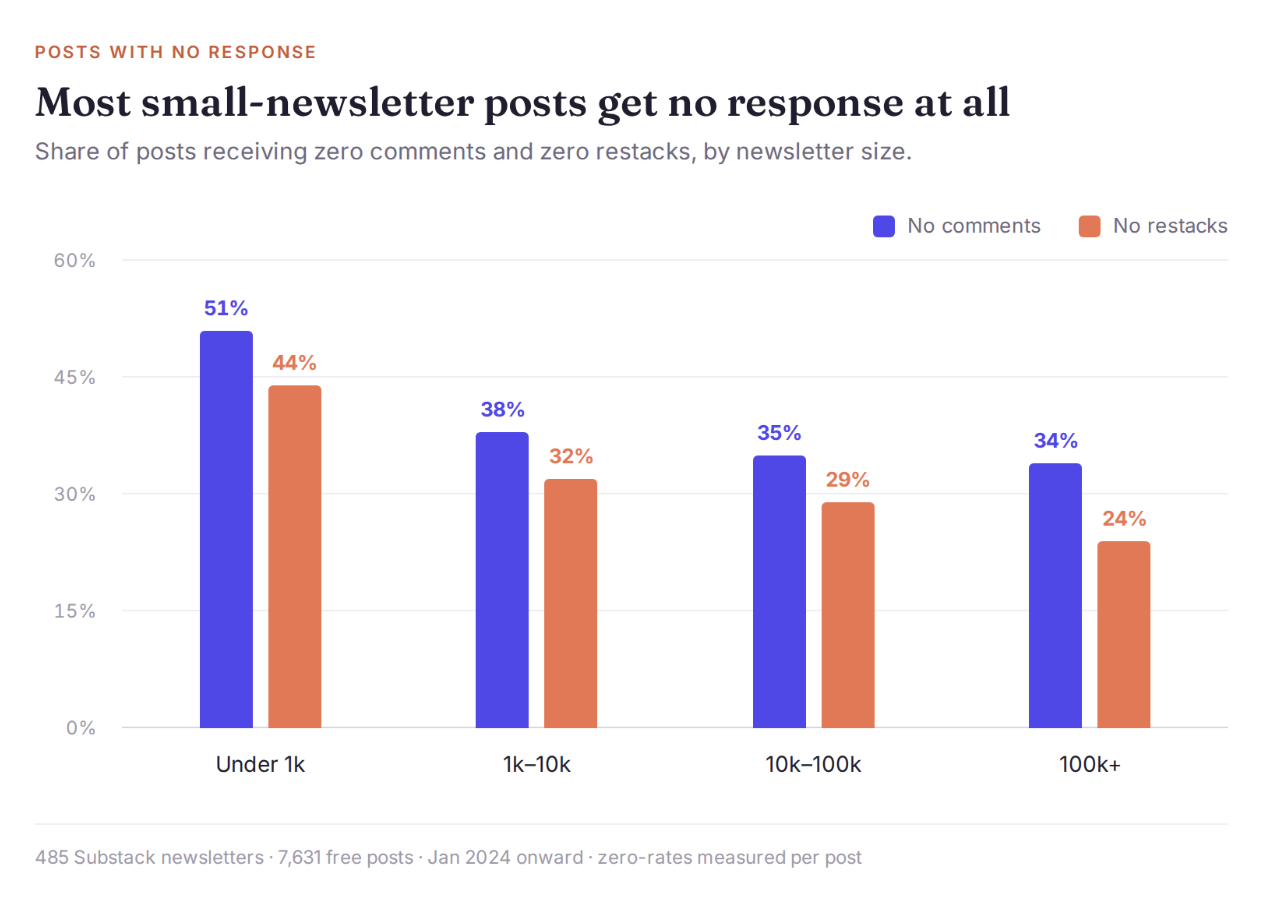
So if you publish to a sub-1k audience and hear nothing back, you probably did nothing wrong. This is a normal, if frustrating, outcome.
The frequency of posts with zero restacks and zero comments declines as audiences grow, but they never go away. Even among newsletters with 100k or more subscribers, about a third of posts (34%) still drew zero comments.
The message here? Low engagement can and does happen to everyone.
The average is misleading you
One thing to keep in mind when you’re reading engagement statistics online for Substack or any platform is that a few random viral posts can drastically skew averages. Among 100k+ newsletters, the median post got 77 likes, but the mean was 335, more than four times higher.
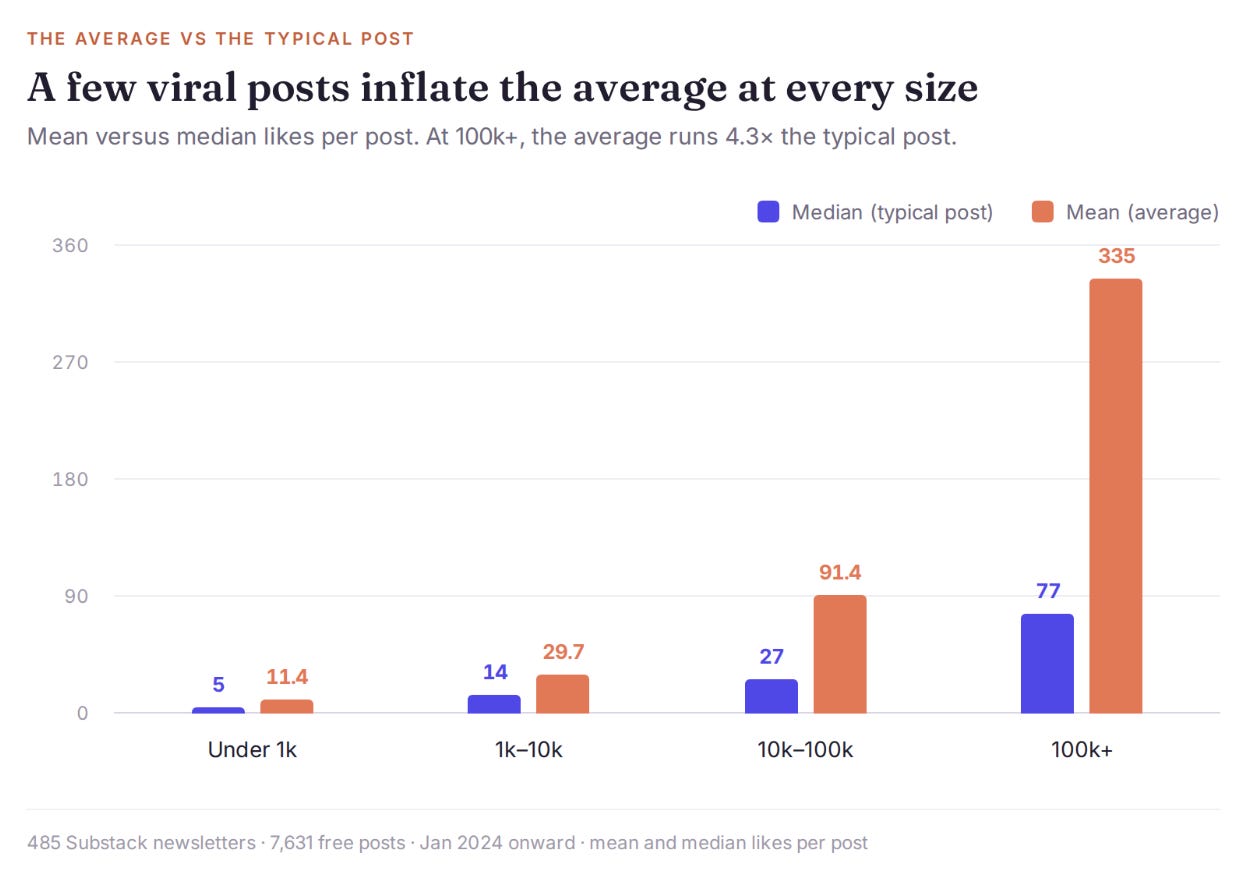
So be careful when you compare your own results to social media “averages,” because they may dramatically overstate how much engagement you can expect even when everything goes right.
You can still break out
All of this can feel discouraging, especially if you’ve been working at it for a few months. My own first month tested my resolve, and I wondered if I’d ever find my audience. But my engagement did grow over time, and while it’s arguable that likes, comments, and even restacks are vanity metrics, they did help me feel seen and motivated enough to stay consistent.
This is what worked for me and what I’d recommend to any new Substack writer:
Spend time in writers’ community chats. This is one of the best ways to meet people, find good work to read, and share your own. When I started, I spent time in communities run by Karo (Product with Attitude) and Daria Cupareanu, who regularly host threads where you can drop a link to your latest piece and also find new things to read.
Comment on other people’s posts. It takes time, but a thoughtful comment is how I met several of the writers I later collaborated with.
Collaborate and write guest posts. Co-writing and guest spots put your work in front of a new audience. Elena | AI Product Leader’s DraftKit is a helpful tool for managing collaborations.
Restack your own posts now and then. A repeat restack is fair game while a post is still finding readers. Be a little shameless about it, within reason.
Don’t forget SEO. Substack’s domain authority is strong, so a well-titled, timeless, and carefully structured post can keep pulling in search traffic long after you publish it. Backlinks can also help. (LinkSwap is an ethical way to build relevant backlinks on Substack.)
I’ve seen other new writers succeed with community building, but I haven’t tested it myself.
What it all means
If you run a small newsletter and it feels like almost no one responds, it’s not all in your head. A typical sub-1k post earns a handful of likes and usually no comments, and that is a totally normal, if annoying, outcome.
If you’re just getting started, ignore the averages you see on social media. They are inflated by viral outliers at every publication size, and they will make solidly good posts look like they’re under-performing.
Also, remember that low early engagement is not a verdict. Most small newsletters struggle with it, but it’s possible to grow your audience over time if you’re patient and willing to keep experimenting.
And raw engagement numbers aren’t the whole story. Many people will read your newsletter in their inbox and not engage at all, even if they found it valuable. And I’ve heard from other writers how “low engagement” posts, if they’re aimed at the right audience, can still attract opportunities.
p.s., Readers on Substack’s website or in the app are much more likely to like, restack, or comment. These differences in behavior are a topic for another post. 🤔
I am working on an article, more or less about this topic, because you mentioned the app.
Substack data shows readers on the app are 15 times more likely to leave a comment than those who aren’t.
There is a lot of invisible readership.
Not to mention the open rates are not very reliable.
So “no comments” often means “no visible signal,” not “no resonance.”
always helpful Karen :)
Now I feel inspired to finish the article lol
Great, as always. I have the 'writing into the void' incorporated into my marketing materials at this point. While it's good to have the knowledge about why I get few responses, I'm sadly a type-a person so that knowledge doesn't make me less annoyed with myself 😸
One thing I've noticed anecdotally since I've been here for a few years toiling in the sub-1000s (until very, very recently) is that it appears harder to stand out and go viral. I wonder if that's measurable?